
MY RANT: EVERYONE IS A COACH AND TRAINER — AND THAT MAY BE PART OF THE PROBLEM
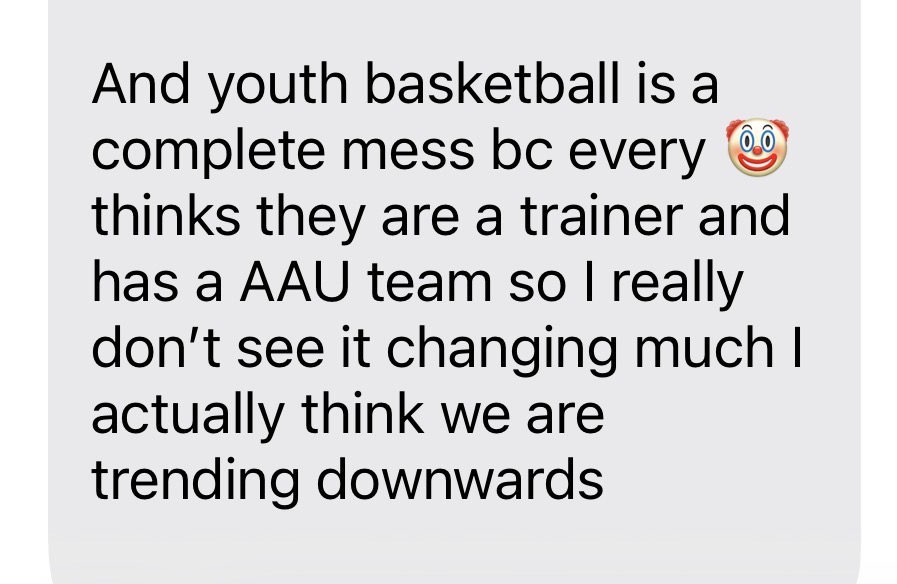
I received this yesterday from one of the best coaches in the country yesterday. I couldn’t AGREE WITH HER MORE! And honestly, I believe that is part of the problem.
Unlike many European basketball systems, where in order to coach you are required to be get certified , the United States has traditionally had a much lower standard to calling yourself a coach or trainer. In many youth programs, there is no meaningful requirement that someone demonstrate that they understand player development before taking responsibility for a group of kids.
What are the requirements?
Sometimes, there really aren’t many.
Find a group of kids. Start a team. Rent a gym. Put some cones on the floor. Run some drills.
And then we wonder why development has become such a mess.
PLAYING EXPERIENCE ISN’T EVERYTHING — BUT LEARNING THE CRAFT IS
I’ve seen coaches with very little basketball background coaching teams.
Some played the game. Some were very good players. Some weren’t.
And some never played a competitive game at all.
That, by itself, doesn’t make someone a bad coach.
You don’t have to be a great player to become a great coach. Some of the best coaches were never stars.
But you do have to learn your craft.
That’s where I believe we are falling short.
Watching basketball isn’t the same as understanding basketball. Watching another coach isn’t the same as learning how to coach. Having a whistle doesn’t automatically make you a coach.
Good coaching requires education, observation, studying film, understanding player development, understanding team development, attending clinics, learning from experienced coaches and, most importantly, being willing to admit that you don’t know everything.
Too many people skip that process.
They simply start coaching and learn through trial and error.
And when young players become the test subjects, that’s a problem.
TRAINING IS NOT COACHING
This is another area where I think people have blurred the lines.
Training and coaching are two completely different jobs.
A trainer can work on shooting, ball handling, footwork, movement, strength, conditioning and individual skills.
But trainers don’t call timeouts.
They don’t make substitutions.
They don’t decide who gets the last shot.
They don’t have to manage a locker room.
They don’t have to make a decision with two seconds left.
They don’t have to manage 12 different personalities while dealing with parents, school, injuries, playing time and winning.
That’s coaching.
And coaching comes with a completely different level of responsibility.
A good coach also has to be honest with players.
You can’t constantly tell every kid they’re amazing.
You can’t tell every parent their daughter is a Division I player.
You can’t tell a player what they want to hear simply because you want them to stay with your program.
Sometimes the most important thing a coach can tell a player is:
“You need to get better.”
THE TRAINER’S RESUME
Today, I see trainers constantly promoting the great players they’ve worked with.
“I trained this player.”
“I worked with that player.”
“Look where this player is now.”
That’s great.
But here’s my question:
What did you actually do to develop that player?
Because a player’s success doesn’t automatically validate a trainer.
A great player was going to be a great player with or without you.
The real question is what you added.
Did you improve their shooting?
Did you improve their decision-making?
Did you make them a better defender?
Did you make them more competitive?
Did you teach them how to practice?
Did you hold them accountable?
Did you make them better when nobody was watching?
That’s development.
THE NEWEST DRILL ISN’T ALWAYS THE BEST DRILL
Basketball has become obsessed with “new.”
New drills.
New gadgets.
New training systems.
New terminology.
New social-media videos.
Everything has to look cutting edge.
But there is nothing new about what really develops players.
Repetition.
Accountability.
Competition.
Fundamentals.
Decision-making.
Consistency.
Hard work.
Sometimes the simplest drills are the most effective.
But simple doesn’t always look impressive on Instagram.
A player dribbling 100 times through a complicated cone routine might look exciting.
But can she make the correct decision when somebody is guarding her?
Can she finish through contact?
Can she make the right pass?
Can she defend?
Can she rebound?
Can she play when she’s tired?
Can she compete?
That’s where development is measured.
THE BIGGEST PROBLEM: THE DEVELOPMENT PROCESS
The development process isn’t always fun.
It requires repetition.
It requires accountability.
It requires doing things over and over again.
It requires being uncomfortable.
And sometimes it requires telling a young player that something isn’t good enough yet.
That’s not always what parents want to hear.
It’s certainly not what every player wants to hear.
But it’s necessary.
Too many programs today are built around keeping everyone happy instead of making everyone better.
And those are two very different things.
PARENTS HAVE TO DO THEIR HOMEWORK TOO
Don’t just listen to somebody because they have a fancy title.
Don’t assume someone understands recruiting because they talk about recruiting.
Don’t assume someone understands college basketball because they have an AAU team.
Don’t assume somebody is a great trainer because they have a picture with a great player.
Ask questions.
What’s their background?
Who have they developed?
How long have they been doing it?
What is their philosophy?
Do they teach the game or just run drills?
Do they make players better?
Do they have a track record?
And most importantly:
Does their track record match what they’re telling you?
EVERYONE WANTS THE ATTENTION
Parents love hearing that their child is special.
Players love hearing that they’re the next big thing.
Everyone loves being told they’re on the “best team.”
Everyone loves rankings.
Everyone loves offers.
Everyone loves social-media attention.
But eventually, there is a moment of truth.
That’s when the things that really mattered become obvious.
Did the player actually develop?
Did she learn how to play?
Did she become more skilled?
Did she become more competitive?
Did she become a better teammate?
Did she learn how to handle adversity?
Did she become prepared for the next level?
That’s judgment day.
And no amount of Instagram posts can hide the answer.
REAL COACHING IS DISAPPEARING
I don’t believe there are fewer talented people capable of coaching.
I believe there are too many people unwilling to go through the process of becoming a coach.
Go to clinics.
Study the game.
Watch film.
Learn from experienced coaches.
Understand player development.
Understand team development.
Learn how to communicate.
Learn how to teach.
Learn how to lead.
And understand that coaching isn’t about having a title.
It’s about having the knowledge and experience to deserve the title.
There are plenty of trainers out there.
There are plenty of coaches.
There are plenty of AAU programs.
But that doesn’t mean there are plenty of good trainers and good coaches.
So my advice to parents is simple:
CHECK THE TRACK RECORD.
CHECK THE BACKGROUND.
ASK QUESTIONS.
WATCH WHAT THEY ACTUALLY DO.
And understand one very important thing:
A TITLE DOESN’T GIVE YOU CREDIBILITY.
Your knowledge does.
Your work does.
Your results do.
And most importantly, the players you develop do.
NBS PRE SEASON PREP REGISTRATION / WEEKLY TRAINING