
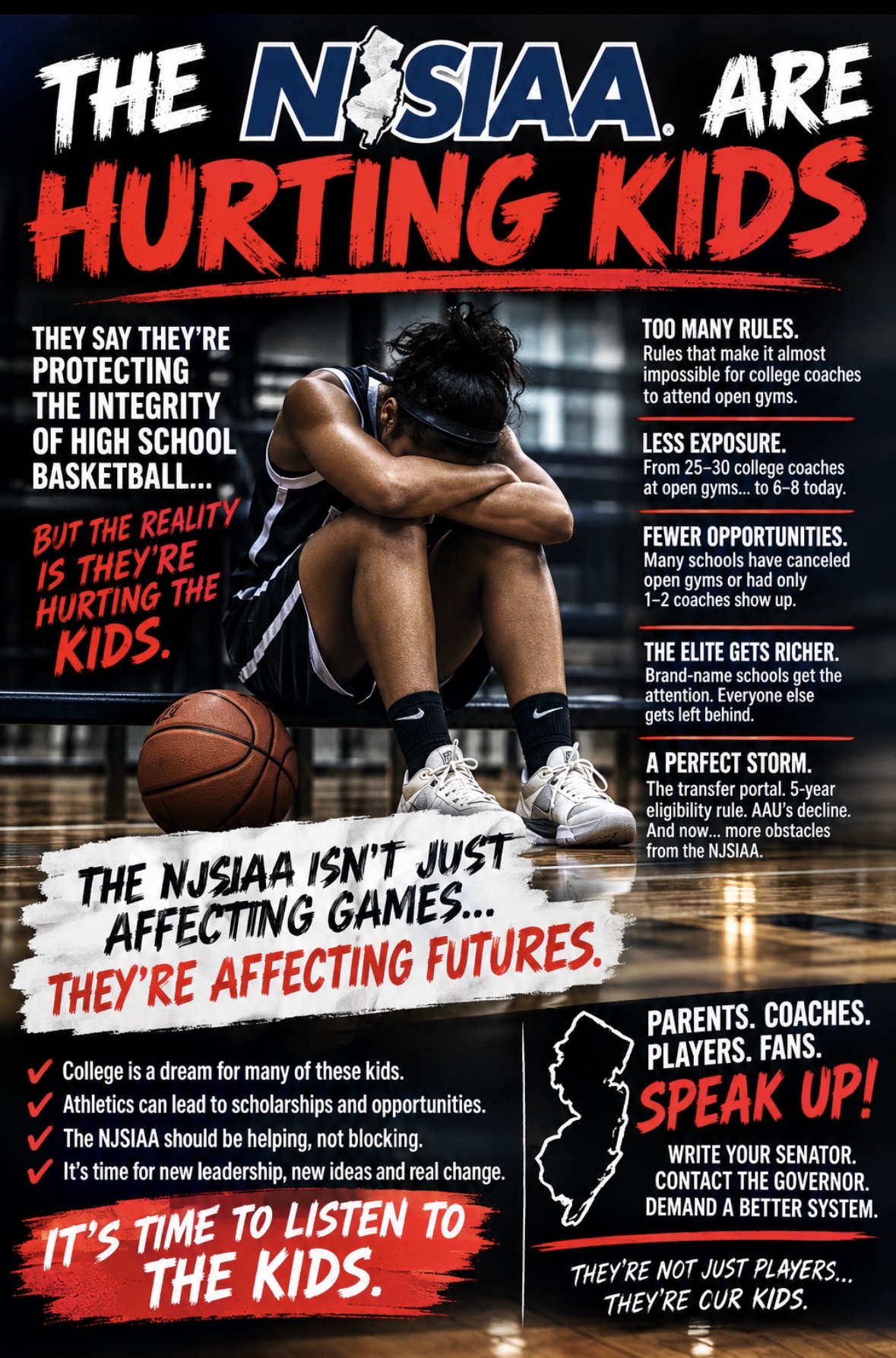
NJSIAA: WHEN PROTECTING HIGH SCHOOL BASKETBALL STARTS HURTING THE KIDS
The high school college open-gym period is basically over.
But here’s the truth:
In New Jersey, it never really started.
College basketball programs around the country are already beginning their practices and preparing for their seasons. College coaches have limited time, limited travel budgets and hundreds of recruiting responsibilities.
So when college coaches have an opportunity to see high school players in the fall, they need the process to be simple.
In New Jersey, it isn’t.
THIS WAS SUPPOSED TO BE ABOUT EXPOSURE
The NJSIAA will tell you that its rules are designed to protect the integrity of high school basketball.
They will tell you the rules are necessary to prevent high school open gyms from becoming disguised practices.
They will tell you they’re trying to create fairness and balance.
I understand that objective.
But at some point, somebody has to ask a very simple question:
Are these rules actually helping New Jersey’s student-athletes?
Because from where I sit, the answer is becoming harder and harder to see.
I won’t go through every NJSIAA open-gym rule here. You can look them up yourself.
What I will tell you is what I’m seeing.
And what I’m seeing is fewer college coaches watching New Jersey high school players.
LOOK AT WHAT USED TO HAPPEN
In previous years, schools such as RBC and SJV could have 25 or even 30 college coaches attend an open gym.
That’s exposure.
That’s opportunity.
That’s college coaches seeing players they might otherwise never get to see.
Today?
We’re talking about numbers more like 6–8 coaches at some open gyms.
And yesterday, RBC reportedly had two coaches and SJV had one.
Yes, it was a Monday. Yes, college practices have started.
But that’s precisely the point.
The window is closing.
And New Jersey has created a system that makes it harder for coaches to use that window.
Other schools have canceled open gyms altogether. Others might have one or two college coaches attend.
So ask yourself:
Who loses?
Not the NJSIAA.
Not the college coach.
Not necessarily the high school.
The kid loses.
THE IRONY IS INCREDIBLE
The NJSIAA says it wants fairness.
But here’s what the current system can produce:
If you’re already playing for a brand-name high school, you have a better chance of having college coaches come watch you.
If you’re playing at a school without a major basketball reputation, your chances of getting seen can be dramatically smaller.
That’s the exact opposite of what fairness should look like.
If a young player wants exposure, the advice today almost becomes:
Go to RBC. Go to SJV. Go to Rutgers Prep. Go to one of the established basketball powers.
Why?
Because college coaches already know those names.
They know the programs.
They know the players.
They know where to look.
And if open gyms are becoming increasingly difficult for college coaches to attend, the established programs have another advantage.
The rich get richer.
THIS IS NOT ABOUT GIVING HIGH SCHOOL COACHES AN ADVANTAGE
I understand the concern.
Nobody wants an open gym to become a secret high school practice.
Nobody wants coaches manipulating the rules.
Nobody wants recruiting disguised as high school activity.
But there has to be a middle ground.
A rule designed to prevent one problem shouldn’t create another problem that may be even more damaging to student-athletes.
College coaches aren’t sitting around waiting for New Jersey high school coaches to run their practices.
They’re trying to recruit.
They’re trying to evaluate players.
They’re trying to build their future rosters.
And they’re being asked to navigate a complicated set of restrictions just to walk into a gym and watch kids play basketball.
That’s not making recruiting better.
It’s making it easier for coaches to stay home.
AND THE TIMING COULDN’T BE WORSE
Look at college basketball today.
The transfer portal has changed roster construction.
Eligibility rules have changed.
Players have more options.
AAU basketball is evolving.
College coaches are under enormous pressure to find players who can help them.
The recruiting landscape isn’t getting simpler.
It’s becoming more complicated.
And New Jersey should be making it easier for legitimate college coaches to evaluate legitimate New Jersey student-athletes.
Instead, we’re adding more obstacles.
THE NUMBERS SHOULD MAKE PEOPLE PAY ATTENTION
Take two of New Jersey’s most prominent girls basketball programs, RBC and SJV.
Between them, there are reportedly 11 unsigned Division I players, with many already holding offers.
These are players college coaches should want to evaluate.
Yet the number of coaches attending their open gyms has dropped dramatically compared with previous years.
If two of the state’s most recognizable programs are struggling to get significant college-coach attendance, imagine what happens at a school without that reputation.
That’s the part the NJSIAA needs to think about.
THE NJSIAA MAY SAY RECRUITING ISN’T ITS RESPONSIBILITY
And technically, they have a point.
The NJSIAA isn’t a recruiting service.
Its primary responsibility is governing interscholastic athletics.
But the organization is responsible for creating rules that affect the athletic experience of New Jersey’s student-athletes.
And for some kids, athletics can be a pathway to college.
It can mean a scholarship.
It can mean admission to a school they otherwise might not have been able to attend.
It can mean an opportunity to continue doing something they’ve spent their entire lives working toward.
So when rules affect the ability of college coaches to see those players, it’s reasonable for parents and coaches to ask whether those rules are accomplishing what they’re supposed to accomplish.
HERE’S THE REAL QUESTION
I’m not asking the NJSIAA to eliminate every rule.
I’m asking them to look at the results.
If the goal is fairness, are these rules creating fairness?
If the goal is protecting high school basketball, are they actually protecting the kids who play it?
If the goal is preventing open gyms from becoming practices, can that goal be accomplished without making college coaches jump through unnecessary hoops?
And most importantly:
Has anyone actually studied the recruiting impact these rules are having on New Jersey student-athletes?
Because if the answer is no, maybe it’s time to start.
NEW JERSEY NEEDS NEW THINKING
This isn’t about attacking individuals.
It’s about questioning a system.
Sports regulations should evolve as the sports themselves evolve.
The recruiting world of 2026 isn’t the recruiting world of 10, 15 or 20 years ago.
College basketball has changed.
AAU has changed.
Recruiting has changed.
The transfer portal has changed.
College eligibility has changed.
But if the rules governing New Jersey high school basketball aren’t keeping pace, then the people making those rules need to take a hard look at themselves.
The kids shouldn’t be the ones paying the price for outdated thinking.
New Jersey has some of the best basketball players in the country.
They deserve every legitimate opportunity to be evaluated.
They deserve rules that protect them without unintentionally limiting them.
And they deserve an organization willing to listen to coaches, parents, college coaches and—most importantly—the student-athletes themselves.
Because at the end of the day, this isn’t supposed to be about protecting an organization.
It’s supposed to be about protecting the kids.
And if the rules aren’t doing that, then it’s time to change the rules.
THE TRUTH STARTS HERE